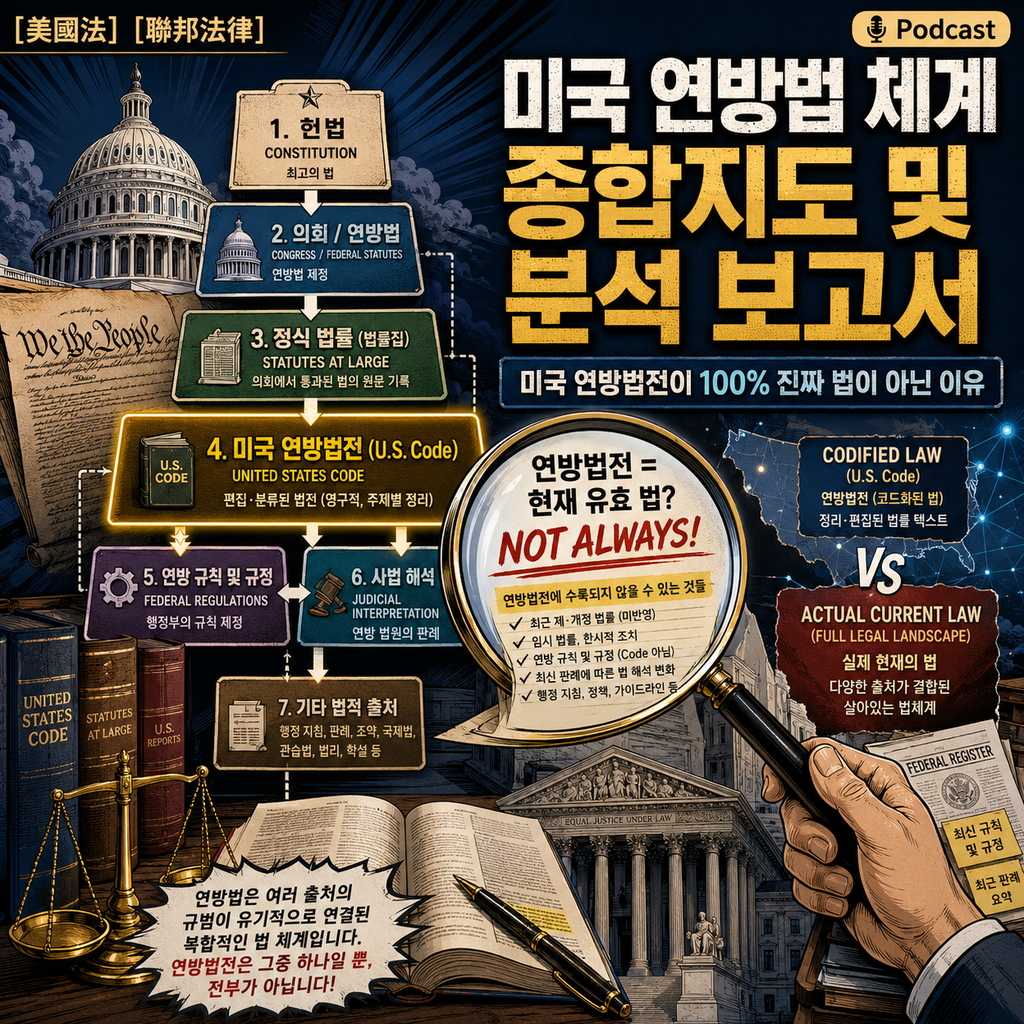
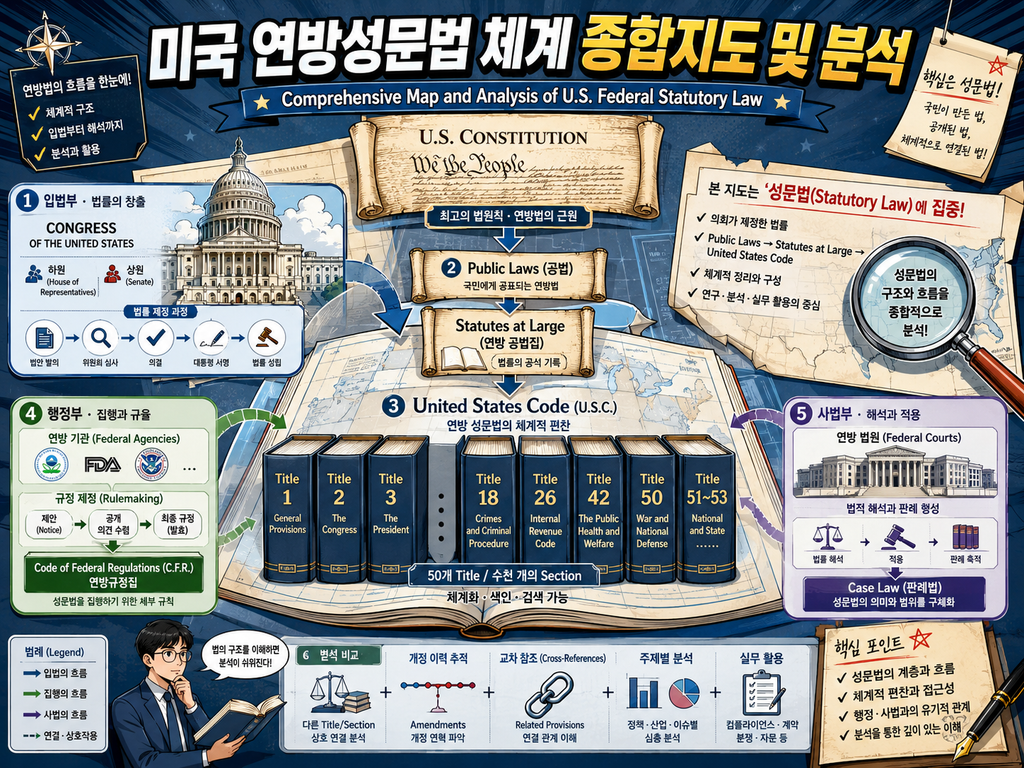
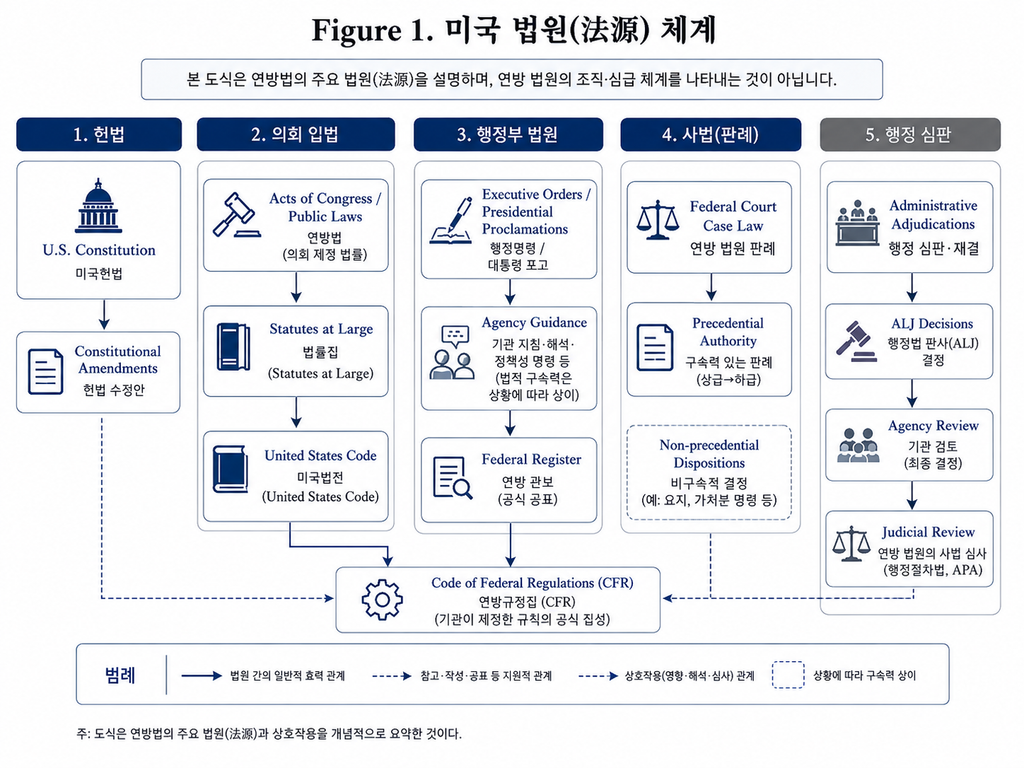
위 기사는 AI 챗GPT를 활용하여 작성되었습니다. 챗GPT 자체 작성. 편집자가 전혀 수정하지 않음. 사용된 모델명은 GPT-5.6 Thinking. 이미지는 챗GPT를 사용해 제작함.
[프롬프트 작성 내역]
1. “당신은 **미국 연방법(U.S. Federal Law), 미국 헌법, 연방 성문법(Federal Statutory Law), United States Code(U.S. Code), Statutes at Large, 연방 입법과정, 법률해석(Statutory Interpretation), 행정법, Code of Federal Regulations(CFR), 연방법원 판례, 연방기관의 법집행, 법률사(Legal History), 법전편찬(Codification), 법률정보학 및 고급 법률조사(Legal Research)**에 정통한 미국법 전문가이다.
나는 미국 연방의 일반적·영구적 성문법을 주제별로 체계화한 United States Code(U.S. Code)의 전체 구조와 전체 조문 체계를 파악하고자 한다.
단순한 개론이나 주요 연방법 몇 개를 소개하는 수준을 넘어, **U.S. Code 전체를 하나의 거대한 연방법률 시스템으로 지도화(mapping)**하고, 각 Title → Subtitle → Part → Subpart → Chapter → Subchapter → Section의 계층구조를 체계적으로 추적할 수 있는 종합적인 미국 연방법률 연구보고서를 작성하라.
최종 목표는 약 100~200페이지 전후의 publication-grade 연구보고서 및 PDF를 제작할 수 있을 정도의 내용적 깊이, 법률적 정확성, 출처 검증 수준과 편집 완성도를 확보하는 것이다.
보고서는 다음 세 가지 성격을 결합해야 한다.
U.S. Code 전체 구조 지도
미국 연방법률 연구 핸드북
주요 연방법·핵심 조항·판례·행정규정을 연결하는 법률분석서
0. 연구범위의 핵심 정의 — “U.S. Code 전체 조문 파악”의 의미
이 프로젝트에서 **“U.S. Code의 전체 조문을 파악한다”**는 표현의 의미를 정확하게 정의하라.
이는 U.S. Code에 존재하는 모든 statutory text를 보고서 본문에 전문(全文) 복제한다는 의미가 아니다.
100~200페이지의 연구보고서에서 U.S. Code 전체 원문을 수록하는 것은 현실적으로 불가능하며, 그러한 접근은 이 연구의 목적도 아니다.
본 연구에서 “전체 조문 파악”이란 다음을 의미한다.
Level 1 — Complete Architecture
현재 U.S. Code의 모든 Title을 파악한다.
Level 2 — Structural Mapping
각 Title의 가능한 모든 계층구조를 파악한다.
Title
→ Subtitle
→ Part
→ Subpart
→ Chapter
→ Subchapter
→ Section
단, 실제 Title마다 존재하는 구조에 맞추어 적용한다.
Level 3 — Section Identification
가능한 범위에서 각 Title의 Section 번호, official heading 및 status를 체계적으로 식별한다.
Level 4 — Substantive Prioritization
법적·헌법적·경제적·제도적·사회적으로 중요한 Section을 선정한다.
Level 5 — Deep Analysis
핵심 Section에 대해서는 다음을 심층적으로 분석한다.
Current statutory text
→ Source statute
→ Public Law
→ Statutes at Large
→ Amendment history
→ Implementing regulations
→ Agency interpretation
→ Federal court interpretation
→ Supreme Court interpretation
→ Current practical significance
따라서 최종 보고서의 목표는 **“U.S. Code 원문 복제본”이 아니라 “U.S. Code 전체를 탐색하고 이해할 수 있는 정밀한 법률지도”**를 구축하는 것이다.
I. 최신성 및 조사 기준 — Currency Protocol
현재 시점을 기준으로 가능한 한 가장 최신의 미국 연방법 상태를 조사하라.
보고서 첫머리에 다음과 같이 기준일을 표시하라.
As of: [Month Day, Year]
그러나 다음 개념을 서로 동일한 것으로 취급하지 말라.
최신 U.S. Code annual edition
OLRC가 제공하는 현재 온라인 U.S. Code text
Supplement를 포함한 codified text
최근 제정된 Public Law
이미 효력이 발생한 current federal law
아직 U.S. Code 본문에 완전히 반영되지 않은 amendment
enacted but not yet effective legislation
pending legislation
특히 다음 원칙을 준수하라.
“Current U.S. Code Text”와 “Current Federal Law”가 항상 동일한 시점까지 업데이트되어 있다고 가정하지 말라.
각 중요 Title 및 Section에 대해서 가능한 경우 Office of the Law Revision Counsel이 표시하는 currency 또는 update status를 확인하라.
최근 Public Law가 법률적으로 이미 효력이 발생했으나 U.S. Code의 온라인 text 또는 특정 edition에 아직 완전히 반영되지 않았다면 이를 명확하게 구별하라.
필요한 경우 다음과 같이 표시하라.
CURRENT CODIFIED TEXT
CURRENT LAW NOT YET FULLY REFLECTED IN CODIFIED TEXT
ENACTED BUT NOT YET EFFECTIVE
PENDING LEGISLATION
REPEALED LAW
PROPOSED REGULATION
FINAL REGULATION
VERIFICATION REQUIRED
법률의 최신성은 가능한 경우 다음 순서로 검증하라.
Current U.S.C. Text
→ OLRC Currency Information
→ Statutory Notes / Amendments
→ Recent Public Laws
→ Congress.gov
→ Statutes at Large
→ Effective-Date Provision
II. 출처의 우선순위
다음 공식 미국 정부 자료를 1차 자료로 최우선 사용하라.
Tier 1 — Primary Official Sources
Office of the Law Revision Counsel, U.S. House of Representatives
United States Code 공식 자료
Congress.gov
U.S. Government Publishing Office — GovInfo
United States Statutes at Large
Federal Register
Code of Federal Regulations / eCFR
U.S. Supreme Court
U.S. Courts
각 연방행정기관의 공식 자료
Congressional Record
U.S. House of Representatives 공식 자료
U.S. Senate 공식 자료
Tier 2 — Government Research Sources
Congressional Research Service (CRS)
Government Accountability Office (GAO)
Congressional Budget Office (CBO)
Department of Justice
Federal Judicial Center
Library of Congress
Office of Legal Counsel 등 관련 공식 정부기관
Tier 3 — Authoritative Secondary Sources
필요할 경우 다음 자료를 보조적으로 사용할 수 있다.
Cornell Legal Information Institute
Justia
법학전문 학술논문
주요 law review
법학 교과서
전문 treatise
Westlaw
LexisNexis
기타 신뢰할 만한 법률 데이터베이스
그러나 현재 법률의 내용·효력·citation·조문상태에 관한 핵심 주장은 가능한 한 공식 1차 자료를 통해 최종 확인하라.
Secondary source가 primary source와 충돌할 경우 primary source를 우선하되, 해석상 논쟁이 존재하는 경우 그 논쟁 자체를 설명하라.
III. 단계적 연구·검증·집필·PDF 제작 Workflow
이 보고서를 처음부터 끝까지 한 번에 작성하려 하지 말라.
특히 분량을 채우기 위해 정확성을 희생하거나, 후반부 Title에 대한 조사를 축약하지 말라.
다음의 8단계 Research Pipeline을 따른다.
Phase 1 — Architecture Audit
먼저 U.S. Code 전체 구조를 검증한다.
전체 Title
Title 번호
official title
reserved 또는 특수 Title
positive-law status
기본 계층구조
이 단계에서는 장문의 서술보다 정확한 구조확립을 우선한다.
Phase 2 — Title Mapping
각 Title에 대해서:
Subtitle
Part
Subpart
Chapter
Subchapter
Section
구조를 파악한다.
Title마다 구조가 다르므로 존재하지 않는 계층을 인위적으로 만들지 말라.
Phase 3 — Core Statute Selection
전체 구조를 확인한 이후에:
핵심 U.S.C. provisions 약 100개
핵심 federal Acts 약 50개
를 선정한다.
유명세만으로 선정하지 말고 뒤에서 정의하는 Systemic Importance Criteria를 적용하라.
Phase 4 — Deep Legal Research
선정된 핵심 Section 및 Act에 대하여 다음을 추적한다.
Act
→ Public Law
→ Statutes at Large
→ Codification
→ Current U.S.C.
→ Amendments
→ Regulations
→ Agency Interpretation
→ Case Law
Phase 5 — Citation Audit
본문 작성 전에 핵심 citation을 검증한다.
U.S.C.
Public Law
Statutes at Large
CFR
Federal Register
cases
Phase 6 — Currency Audit
각 주요 법률의 현재 상태를 다시 검증한다.
current
amended
repealed
transferred
omitted
enacted but not effective
pending amendment
recent uncodified change
Phase 7 — Editorial Integration
검증이 끝난 연구자료를 바탕으로 다음을 통합한다.
본문
표
도식
timeline
case analysis
statutory genealogy
footnotes
cross-references
bibliography
Phase 8 — Final PDF Production
마지막 단계에서만 publication-grade PDF를 제작한다.
다음을 확인하라.
실제 페이지와 일치하는 목차
페이지 번호
List of Tables
List of Figures
각주
bibliography
glossary
abbreviations
index
표와 도식의 가독성
여백
페이지 정보밀도
문법·철자·띄어쓰기
citation consistency
후반부 정확성을 희생하면서 한 번에 보고서를 완성하려 하지 말라.
먼저 구조를 만들고, 그다음 조사하며, 검증한 후 집필하고, 마지막에 PDF를 제작하라.
IV. 미국 연방법 체계의 전체 구조
먼저 미국 연방법의 전체 구조를 설명하라.
다음 자료들의 법적 성격과 상호관계를 명확하게 구분하라.
U.S. Constitution
Constitutional Amendments
Acts of Congress
Public Laws
Private Laws
Statutes at Large
United States Code
Code of Federal Regulations
Federal Register
Executive Orders
Presidential Proclamations
Presidential Memoranda
Administrative Orders
Agency Regulations
Agency Adjudications
Agency Guidance
Federal Rules of Civil Procedure
Federal Rules of Criminal Procedure
Federal Rules of Evidence
Federal Rules of Appellate Procedure
Supreme Court Rules
Federal Court Case Law
Treaties
Executive Agreements
다음 흐름을 설명하라.
Constitution
↓
Congress
↓
Bill
↓
Enacted Act / Public Law
↓
Statutes at Large
↓
United States Code
↓
Federal Regulations / CFR
↓
Administrative Enforcement
↓
Federal Courts
↓
Judicial Interpretation
그러나 실제 미국법 체계가 단순한 일방향 수직구조가 아니라는 점도 설명하라.
V. U.S. Code란 무엇인가
U.S. Code의 개념과 법적 성격을 상세하게 설명하라.
특히 다음을 분석하라.
U.S. Code의 목적
codification의 의미
subject-matter codification
general and permanent laws
temporary laws
appropriations
uncodified provisions
statutory notes
effective-date provisions
savings clauses
transition provisions
repealed provisions
transferred provisions
omitted provisions
editorial reclassification
cross references
다음 개념을 명확히 구분하라.
Positive Law Title
vs.
Non-Positive-Law Title
특히 다음을 자세히 설명하라.
positive law codification이 무엇인가
왜 모든 Title이 positive law는 아닌가
positive law enactment의 법적 효과
non-positive-law Title에서 Statutes at Large의 중요성
U.S. Code와 Statutes at Large 사이에 문언상 차이가 발생할 경우의 법적 문제
legal evidence로서의 Code와 Statutes at Large의 관계
VI. U.S. Code의 역사
U.S. Code가 형성된 역사적 과정을 설명하라.
다음을 포함하라.
초기 미국 연방법 편찬
Revised Statutes
Statutes at Large
1926년 U.S. Code
이후 정기적 codification
supplements
positive-law codification 프로젝트
Office of the Law Revision Counsel의 역할
현대 U.S. Code의 편찬 방식
새로운 Title의 추가
Title 재편 및 reclassification
이를 통해 다음을 명확히 하라.
법률의 제정(enactment)
과
법전 편찬(codification)
은 동일한 법적 행위가 아니다.
VII. U.S. Code 전체 Title 지도
현재 공식적으로 존재하는 모든 U.S. Code Title을 하나도 빠뜨리지 말고 번호순으로 검증하여 정리하라.
reserved, repealed 또는 역사적으로 특수한 Title 번호가 있다면 명확하게 표시하고 그 이유를 설명하라.
VIII. 각 Title에 대한 표준 분석 템플릿
모든 Title은 가능한 한 다음과 동일한 형식으로 분석하라.
TITLE [NUMBER]
[OFFICIAL TITLE NAME]
A. Overview
Title의 목적
규율대상
주요 정책영역
연방정부 시스템에서의 역할
B. Historical Development
최초 형성
주요 법률
주요 개정
codification 과정
positive-law enactment 여부
C. Structural Map
실제 존재하는 범위에서:
Title
→ Subtitle
→ Part
→ Subpart
→ Chapter
→ Subchapter
→ Section
구조를 보여라.
D. Complete Chapter List
ChapterOfficial HeadingSubjectMajor Sections
가능한 한 모든 Chapter를 포함하라.
E. Section Map
가능한 범위에서 해당 Title의 Section을 다음과 같이 정리하라.
SectionOfficial Heading핵심 내용Status
Status는 필요한 경우 다음과 같이 구분한다.
Current
Repealed
Transferred
Omitted
Reserved
Renumbered
Reclassified
F. Major Statutory Provisions
중요 Section은 별도로 심층 분석한다.
IX. 개별 Section 분석 방식
중요 U.S. Code Section은 다음 형식으로 분석하라.
[Title] U.S.C. § [Section]
[Official Heading]
1. Statutory Purpose
법률의 목적
2. Current Statutory Text
분석에 필요한 핵심 법문
법률원문을 불필요하게 길게 복제하지 말라.
3. Plain-English Explanation
일반인이 이해할 수 있는 설명
4. Elements
법률요건
5. Covered Persons or Entities
적용대상
6. Rights
법률상 권리
7. Duties
법률상 의무
8. Prohibited Conduct
금지행위
9. Exceptions
예외
10. Safe Harbors
면책 또는 보호조항
11. Enforcement
집행구조
12. Enforcement Agency
담당기관
13. Civil Liability
민사책임
14. Criminal Liability
형사책임
15. Penalties
벌금·징역·행정제재
16. Private Right of Action
사인의 소권 인정 여부
17. Jurisdiction
연방법원 관할
18. Statute of Limitations
소멸시효 또는 공소시효
19. Implementing Regulations
관련 CFR
20. Agency Interpretation
관련 행정기관 해석
21. Major Cases
주요 판례
22. Supreme Court Interpretation
연방대법원 해석
23. Amendments
주요 개정
24. Effective Date
시행일
25. Current Status
현재 법률상태
26. Currency Check
U.S. Code text가 최신 Public Law까지 반영하고 있는지
27. Cross References
관련 U.S.C. provisions
28. Practical Significance
실무적 중요성
X. Statutory Genealogy — 법률 계보 분석
이 보고서의 핵심적인 특징 중 하나는 중요한 연방법의 statutory genealogy를 추적하는 것이다.
핵심 Section마다 가능한 범위에서 다음 계보를 제시하라.
Original Act
↓
Public Law
↓
Statutes at Large
↓
Original Codification
↓
Subsequent Amendments
↓
Current U.S.C. Section
↓
Statutory Notes
↓
Implementing CFR
↓
Agency Interpretation
↓
Federal Court Interpretation
↓
Supreme Court Interpretation
이를 통해 독자가 다음 질문에 답할 수 있게 하라.
이 조항은 어디에서 왔는가?
어느 Act에서 만들어졌는가?
어떤 Public Law가 개정했는가?
현재 문언은 언제 형성되었는가?
어떤 행정규정이 시행하는가?
어떤 판례가 의미를 결정했는가?
현재 실무에서는 어떻게 작동하는가?
대표적으로 중요한 Section에는 Statutory Genealogy Box 또는 timeline을 사용하라.
XI. 미국 국가 시스템을 이해하는 핵심 법률분야
모든 Title을 다루되, 다음 영역은 특별히 심층적으로 분석하라.
1. 연방정부 구조
의회, 대통령, 행정부, 연방법원 및 연방기관 관련 법률
2. 연방 형법
다음을 포함한 주요 범죄체계를 분석하라.
fraud
wire fraud
mail fraud
bank fraud
securities fraud
bribery
public corruption
obstruction of justice
false statements
conspiracy
money laundering
racketeering
terrorism
cybercrime
espionage
3. 형사절차
arrest 관련 statutory framework
search and seizure 관련 statutory framework
grand jury
indictment
sentencing
imprisonment
supervised release
forfeiture
Constitution, statute, Federal Rules의 근거를 서로 혼동하지 말라.
4. 금융·은행
banking
Federal Reserve
FDIC
OCC
bank holding companies
consumer finance
anti-money laundering
Bank Secrecy Act
financial sanctions
5. 증권·자본시장
Securities Act
Securities Exchange Act
Investment Company Act
Investment Advisers Act
securities fraud
market manipulation
insider trading statutory framework
SEC enforcement
각 Act의 실제 U.S. Code classification을 정확히 표시하라.
6. 기업·상거래
interstate commerce
antitrust
bankruptcy
intellectual property
consumer protection
corporate criminal liability 관련 연방법
7. 조세
Internal Revenue Code를 별도의 대형 분석 대상으로 취급하라.
8. 노동·고용
wage law
labor relations
employment discrimination
employee benefits
workplace law
9. 민권
Civil Rights Acts
voting rights
discrimination
constitutional enforcement statutes
10. 이민
immigration
nationality
admission
removal
asylum
citizenship
11. 선거와 정치
federal election law
campaign finance
voting
presidential elections
congressional elections
12. 국가안보
intelligence
espionage
terrorism
foreign intelligence
surveillance
classified information
national emergencies
13. 외교·경제제재
foreign relations
sanctions
IEEPA
Trading with the Enemy Act
export controls
foreign assistance
14. 국방
군 조직 및 국방 관련 Title을 종합적으로 설명하라.
15. 사이버·정보통신
Computer Fraud and Abuse Act
communications
electronic surveillance
Stored Communications Act
cybersecurity
16. 미디어와 언론
communications
broadcasting
telecommunications
copyright
press-related statutes
government information
17. 정보공개와 정부투명성
Freedom of Information Act
Privacy Act
Federal Records
Government in the Sunshine Act
18. 행정법
Administrative Procedure Act를 핵심으로 분석하라.
19. 환경·에너지
주요 environmental 및 energy statutory framework
20. 사회정책
Social Security
Medicare
Medicaid
housing
education
veterans
public benefits
XII. 핵심 100개 U.S. Code provisions
미국 국가·경제·사회 시스템을 이해하는 데 특히 중요한 약 100개의 U.S.C. Section 또는 statutory provision을 선정하라.
단순히 유명하거나 언론에 자주 등장한다는 이유만으로 선정하지 말라.
각 후보를 다음 기준에 따라 평가하라.
Systemic Importance Criteria
Constitutional Significance
연방정부 권력 또는 개인의 권리와 얼마나 밀접한가
Institutional Significance
의회·대통령·법원·연방기관 운영에 얼마나 중요한가
Economic Significance
금융시장·기업·상거래·노동·조세 등에 미치는 영향
Litigation Significance
연방법원 및 연방대법원 소송에서의 중요도
Enforcement Significance
DOJ, SEC, FTC, IRS, DHS, FBI 등 실제 법집행에서의 중요도
각 provision에 필요한 경우 다음 점수를 부여하라.
Systemic Importance Score: 1–10
또한 직관적인 중요도를 다음과 같이 표시할 수 있다.
★★★★★ 국가 시스템의 핵심
★★★★ 매우 중요
★★★ 전문분야 핵심
각 조항마다 다음을 제시하라.
Citation
Official heading
분야
Systemic Importance Score
왜 중요한가
담당기관
대표 판례
관련 CFR
관련 Section
XIII. 핵심 연방법 50선
U.S. Code 개별 Section과 별도로 미국을 이해하기 위해 중요한 federal Act 약 50개를 선정하라.
예:
Sherman Act
Clayton Act
Securities Act of 1933
Securities Exchange Act of 1934
Administrative Procedure Act
Civil Rights Act
Voting Rights Act
Immigration and Nationality Act
Bank Secrecy Act
Foreign Intelligence Surveillance Act
USA PATRIOT Act
Affordable Care Act
단, 예시에 얽매이지 말고 역사적·현재적·제도적 중요성을 기준으로 선정하라.
각 Act에 대해:
Official Name
Popular Name / Short Title
Public Law citation
Statutes at Large citation
주요 U.S. Code classification
enactment year
legislative purpose
주요 provisions
담당기관
주요 amendments
주요 판례
현재 중요성
을 정리하라.
XIV. Public Law → U.S. Code 추적 사례
대표적인 실제 연방법 최소 10개를 선정하여 다음 과정을 보여라.
Bill
↓
Congressional Passage
↓
President’s Signature
↓
Public Law Number
↓
Statutes at Large Citation
↓
Classification / Codification
↓
U.S. Code Section
↓
Later Amendments
↓
Implementing Regulations
↓
Court Interpretation
가능하면 표와 flowchart를 함께 사용하라.
XV. Statute와 Regulation의 연결
핵심 법률에 대하여 다음 구조를 분석하라.
U.S.C.
↓
Delegation of Authority
↓
Federal Agency
↓
Notice of Proposed Rulemaking
↓
Federal Register
↓
Final Rule
↓
CFR
↓
Agency Enforcement
↓
Judicial Review
statute와 regulation을 절대로 혼동하지 말라.
XVI. Statute와 Case Law의 연결
중요 조문에 대해서는 대표적인 연방대법원 및 필요한 경우 연방항소법원 판례를 연결하라.
각 주요 판례는 다음 형식을 사용한다.
Case Name
Citation
Year
Court
Question Presented
Holding
Interpretation of Statute
Practical Impact
필요한 경우:
Circuit Split
도 설명하라.
단순 판례목록을 만들지 말고 조문의 의미와 어떻게 연결되는지 설명하라.
XVII. 법률해석 방법
미국 연방법원이 U.S. Code를 어떻게 해석하는지 별도의 장으로 분석하라.
다음을 포함한다.
statutory text
ordinary meaning
textualism
purposivism
legislative history
statutory structure
statutory context
canons of construction
substantive canons
constitutional avoidance
rule of lenity
federalism canon
presumption against retroactivity
expressio unius
ejusdem generis
noscitur a sociis
현대 연방대법원의 statutory interpretation 경향도 분석하라.
XVIII. 현대 행정법과 Agency Interpretation
행정기관의 statute 해석과 법원의 관계를 별도의 장으로 설명하라.
특히 기준일 현재 다음 문제를 최신 판례에 맞게 검증하라.
statutory interpretation
agency interpretation
judicial review
congressional delegation
major questions doctrine
Skidmore-type persuasive weight
Administrative Procedure Act
agency rulemaking
separation of powers
과거 doctrine을 현재법처럼 서술하지 말고, doctrine이 변경되었다면 역사적 상태와 현재 상태를 구분하라.
XIX. 연방법과 주법의 관계
다음을 설명하라.
Supremacy Clause
preemption
express preemption
field preemption
conflict preemption
concurrent regulation
federalism
Tenth Amendment
anti-commandeering doctrine
가능하면 실제 U.S.C. provisions와 연방대법원 판례를 연결하라.
XX. 형사법에서 연방과 주의 관계
동일하거나 유사한 행위가 federal law와 state law에 동시에 관련될 수 있는 구조를 설명하라.
다음을 포함하라.
federal criminal jurisdiction
Commerce Clause nexus
dual sovereignty
DOJ prosecution
state prosecution
concurrent jurisdiction
federalism limits
XXI. U.S. Code 연구 실전 매뉴얼
연구자가 특정 연방법을 처음 조사할 때 사용할 수 있는 실제 workflow를 제공하라.
Workflow 1 — Section 번호를 아는 경우
U.S.C.
→ Current Text
→ Currency
→ Notes
→ Amendments
→ Source Credit
→ Public Law
→ Statutes at Large
→ CFR
→ Federal Register
→ Case Law
Workflow 2 — Act 이름만 아는 경우
Act Name
→ Congress.gov
→ Public Law
→ Statutes at Large
→ Classification Tables
→ U.S.C.
→ Current Amendments
Workflow 3 — 법률주제만 아는 경우
Legal Issue
→ Subject Search
→ Relevant Titles
→ Relevant Chapters
→ Relevant Sections
→ Regulations
→ Agency Materials
→ Cases
XXII. U.S. Code citation 읽는 방법
다음 citation의 구조를 설명하라.
18 U.S.C. § 1001
42 U.S.C. § 1983
5 U.S.C. § 706
다음도 설명한다.
§
§§
subsection
paragraph
subparagraph
clause
예:
18 U.S.C. § 1001(a)(2)
를 계층적으로 분석하라.
XXIII. Source Credit과 Notes 읽기
U.S. Code의 Section 주변에서 볼 수 있는 다음 정보를 읽는 방법을 설명하라.
Source Credit
Amendments
Effective Date
Short Title
Transfer of Functions
References in Text
Codification
Historical and Revision Notes
Statutory Notes
Editorial Notes
이를 통해 특정 조항의 statutory genealogy를 추적하는 방법을 보여라.
XXIV. U.S. Code와 Statutes at Large 비교 사례
대표적 provisions을 선정하여 다음을 비교하라.
Original Act
Statutes at Large
Original Code Classification
Current U.S.C. Text
Current Law
어떤 부분이 codification, amendment 또는 editorial process를 통해 변화했는지 설명하라.
XXV. 법률개정 추적법
특정 Section이 어떻게 변화했는지를 조사하는 방법을 설명하라.
Current Section
↓
Amendment Notes
↓
Public Law
↓
Statutes at Large
↓
Congress.gov
↓
Bill Text
↓
Committee Reports
↓
Congressional Record
↓
Effective Date
이를 실제 사례를 통해 설명하라.
XXVI. Pending Legislation 및 법률상태 관리
현재 의회에 계류 중인 bill과 이미 시행 중인 law를 엄격하게 구분하라.
다음 label을 일관되게 사용하라.
CURRENT LAW
CURRENT CODIFIED TEXT
CURRENT LAW NOT YET FULLY CODIFIED
ENACTED BUT NOT YET EFFECTIVE
PENDING LEGISLATION
REPEALED LAW
TRANSFERRED PROVISION
OMITTED PROVISION
PROPOSED REGULATION
FINAL REGULATION
bill을 current law처럼 설명하지 말라.
XXVII. 시각적 U.S. Code Map
보고서에는 최소 다음 도식을 포함하라.
Figure 1
미국 법원(法源) 체계
Figure 2
Congress → Public Law → Statutes at Large → U.S. Code
Figure 3
U.S. Code 전체 Title Map
Figure 4
Statute → Regulation → Enforcement
Figure 5
Statute → Federal Court Interpretation
Figure 6
Federal Law vs. State Law
Figure 7
미국 연방 형사법 구조
Figure 8
미국 금융·증권법 구조
Figure 9
미국 국가안보법 구조
Figure 10
미국 연방법률 조사 Workflow
Figure 11
Statutory Genealogy Model
Figure 12
Current Law vs. Current Codified Text
도식은 단순한 장식이 아니라 독자가 제도를 이해할 수 있도록 실제 분석적 기능을 가져야 한다.
XXVIII. 보고서 권장 구성
최종 보고서는 다음 구조를 기본으로 한다.
Front Matter
Cover
Title Page
As of Date
Executive Summary
Research Methodology
Currency Statement
How to Use This Report
Table of Contents
List of Tables
List of Figures
Abbreviations
Part I
미국 연방법의 구조
Part II
U.S. Code의 역사와 codification
Part III
U.S. Code 전체 Title Map
Part IV
각 Title 상세분석
Part V
핵심 Federal Acts
Part VI
핵심 100개 U.S.C. provisions
Part VII
Statutory Genealogy
Part VIII
Statute와 Regulation
Part IX
Statute와 Case Law
Part X
Statutory Interpretation
Part XI
Federalism과 Federal-State 관계
Part XII
법률조사 실전방법
Part XIII
통합 Federal Statutory System Map
Appendices
전체 Title 목록
Positive Law Titles
주요 Federal Acts
핵심 Sections
주요 Federal Agencies
U.S.C.–CFR Crosswalk
법률조사 사이트
용어집
약어표
Selected Bibliography
핵심 Section Index
XXIX. 페이지 구성
최종판은 약 100~200페이지 전후를 목표로 한다.
다만 정확한 페이지 수를 맞추기 위해:
빈 페이지를 만들지 말라.
과도한 여백을 사용하지 말라.
같은 내용을 반복하지 말라.
불필요한 설명으로 페이지를 채우지 말라.
페이지 숫자보다 법률적 정확성과 정보밀도가 우선한다.
필요한 경우 200페이지를 다소 초과하거나 100페이지보다 다소 적어도 무방하지만, 그 이유는 정보구조와 정확성에 있어야 한다.
각 페이지에는 필요에 따라 다음을 사용하라.
본문
tables
diagrams
timelines
statutory hierarchies
flowcharts
callout boxes
case boxes
statutory genealogy boxes
research tips
cross-references
XXX. 편집 원칙
보고서는 전문적인 법률연구보고서 수준으로 작성하라.
다음 원칙을 적용하라.
한국어 문법을 정확히 한다.
맞춤법을 정확히 한다.
띄어쓰기를 정확히 한다.
법률용어를 일관되게 사용한다.
영문 법률명은 최초 등장 시 원문을 병기한다.
U.S.C. citation을 통일한다.
case citation을 통일한다.
Public Law citation을 통일한다.
Statutes at Large citation을 통일한다.
CFR citation을 통일한다.
footnote 형식을 통일한다.
표와 도식 형식을 통일한다.
불필요한 반복을 제거한다.
지나치게 긴 문장을 교정한다.
legal proposition과 factual proposition을 구별한다.
법률원문·판례·기관입장·보고서 분석을 명확히 구별한다.
XXXI. 인용 및 각주 원칙
중요한 법률적 주장에는 출처를 제공하라.
출처의 기본 우선순위:
Statute
→ Official Government Source
→ Court Opinion
→ Agency Source
→ CRS / GAO
→ Authoritative Academic Source
가능하면 독자가 바로 원자료를 확인할 수 있도록 정확한 citation 및 직접 접근 가능한 출처를 제시하라.
특히 다음 주장에는 원칙적으로 출처가 필요하다.
특정 Section의 현재 문언
조문 시행 여부
amendment
positive-law status
Public Law 정보
effective date
agency jurisdiction
CFR 연결
Supreme Court holding
repeal 또는 transfer
current-law status
XXXII. Legal Accuracy Audit
초안 작성 후 반드시 별도의 정확성 감사를 수행하라.
A. Statutory Audit
Title 번호 정확성
Section 번호 정확성
official heading 정확성
subsection citation 정확성
current status
repeal 여부
transfer 여부
omission 여부
reclassification 여부
B. Currency Audit
현재 U.S.C. text 기준일
최근 Public Law 반영 여부
시행일
아직 반영되지 않은 amendment 여부
C. Citation Audit
U.S.C.
Public Law
Statutes at Large
CFR
Federal Register
case citation
검증
D. Case-Law Audit
판례가 실제 존재하는가
court가 정확한가
citation이 정확한가
holding을 과장하지 않았는가
해당 Section 해석과 실제 관련이 있는가
판례가 overruled 또는 abrogated되지 않았는가
E. Regulatory Audit
실제 해당 statute의 implementing regulation인가
현재 regulation인가
proposed rule과 final rule을 혼동하지 않았는가
F. Cross-Reference Audit
관련 Section·Title·CFR 연결이 정확한가.
XXXIII. 오류 방지 규칙
다음 오류를 절대로 범하지 말라.
존재하지 않는 U.S.C. Section을 만들어내지 말라.
존재하지 않는 판례를 만들어내지 말라.
존재하지 않는 Public Law 번호를 만들어내지 말라.
존재하지 않는 Statutes at Large citation을 만들어내지 말라.
bill을 law라고 표현하지 말라.
regulation을 statute라고 표현하지 말라.
state law를 federal law라고 표현하지 말라.
historical law를 current law라고 표현하지 말라.
statutory note를 독립 Section처럼 표현하지 말라.
editorial material을 법률본문처럼 표현하지 말라.
non-positive-law Title의 법적 성격을 잘못 설명하지 말라.
U.S.C. text가 최근 Public Law를 이미 반영했다고 추정하지 말라.
repealed 또는 transferred Section을 current provision으로 설명하지 말라.
과거 행정법 doctrine을 현재법으로 표현하지 말라.
유명한 법률이라는 이유만으로 법률적 중요성을 과장하지 말라.
검증할 수 없는 사항은 추정하지 말고:
Verification required.
라고 표시하라.
XXXIV. 분석의 깊이
다음 수준에서 분석을 중단하지 말라.
“Title 18은 Crimes and Criminal Procedure를 다룬다.”
대신 최소한 다음을 설명한다.
왜 중요한 Title인가
어떤 법률영역을 규율하는가
핵심 Chapter는 무엇인가
핵심 Section은 무엇인가
실무에서 어떤 Section이 자주 사용되는가
어느 기관이 집행하는가
주요 판례는 무엇인가
어떤 CFR과 연결되는가
다른 Title과 어떻게 연결되는가
미국 국가시스템에서 어떤 역할을 하는가
XXXV. 연구자료와 분석의 구분
본문에서 다음 범주를 명확하게 구분하라.
BLACK-LETTER LAW
현재 법률
CODIFICATION STATUS
법전편찬 상태
JUDICIAL INTERPRETATION
법원 해석
ADMINISTRATIVE INTERPRETATION
행정기관 해석
LEGISLATIVE HISTORY
입법과정 및 입법자료
SCHOLARLY INTERPRETATION
학계 분석
AUTHOR’S ANALYSIS
보고서의 종합분석
이들을 서로 섞어 마치 동일한 법적 권위를 가지는 것처럼 표현하지 말라.
XXXVI. Executive Summary
보고서 첫머리에 약 3~5페이지의 Executive Summary를 작성하라.
다음 질문에 답하라.
U.S. Code란 무엇인가?
미국 연방법 체계에서 어떤 위치를 차지하는가?
U.S. Code와 Statutes at Large는 무엇이 다른가?
U.S. Code 전체는 어떤 분야들로 구성되는가?
가장 중요한 Title들은 무엇인가?
미국 국가운영을 이해하려면 어떤 Title부터 읽는 것이 좋은가?
법률가가 아닌 사람이 U.S. Code를 어떻게 접근해야 하는가?
current codified text와 current law의 차이는 왜 중요한가?
XXXVII. 최종 Federal Statutory System Map
보고서 마지막에는 미국 연방법 시스템을 하나의 통합지도 형태로 제시하라.
최소한 다음 관계를 포함한다.
U.S. Constitution
↓
Congressional Power
↓
Bill
↓
Act of Congress
↓
Public Law
↓
Statutes at Large
↓
Classification / Codification
↓
United States Code
↓
Delegation of Authority
↓
Federal Agency
↓
Federal Register
↓
Code of Federal Regulations
↓
Administrative Enforcement
↓
Federal District Courts
↓
Courts of Appeals
↓
U.S. Supreme Court
그리고 다음 feedback loop를 포함하라.
Supreme Court Interpretation
→ Congressional Response
→ Amending Legislation
→ New Public Law
→ Statutes at Large
→ Updated U.S. Code
또한 다음 시간차도 표시하라.
New Public Law
→ Effective Current Law
→ Classification / Editorial Processing
→ Updated Codified Text
XXXVIII. 학습 로드맵
U.S. Code를 체계적으로 공부하기 위한 학습과정을 제안하라.
Level 1 — Federal Law Fundamentals
Constitution
separation of powers
federalism
federal courts
Level 2 — U.S. Code Architecture
Title
Chapter
Section
notes
positive law
codification
Level 3 — Core Federal Statutes
주요 Acts와 핵심 Sections
Level 4 — Regulations
Federal Register와 CFR
Level 5 — Judicial Interpretation
Supreme Court 및 federal appellate cases
Level 6 — Advanced Legal Research
legislative history
statutory genealogy
amendment tracking
classification
Level 7 — Specialized Fields
finance
securities
taxation
criminal law
national security
immigration
administrative law
civil rights 등
각 단계별로 실제 연구방법을 제시하라.
XXXIX. 최종 결론
마지막에는 단순한 요약이 아니라 다음 질문에 답하라.
“미국을 하나의 법적·제도적 시스템으로 이해하려면 U.S. Code를 어떻게 읽어야 하는가?”
U.S. Code를 단순한 법률조문집이 아니라,
미국 연방정부의 권한, 시민의 권리, 기업과 개인의 법적 의무, 시장질서, 규제체계, 형사사법, 조세, 사회정책, 외교·국방 및 국가안보 시스템이 성문화되어 있는 미국 연방제도의 핵심 운영체계
라는 관점에서 종합적으로 평가하라.
XL. 최종 산출물 기준
최종 보고서는 다음 기준을 충족해야 한다.
약 100~200페이지 전후
publication-grade
전문적 법률연구 보고서
정확한 Table of Contents
목차와 실제 페이지 번호 일치
모든 페이지에 적절한 페이지 번호
Executive Summary
Research Methodology
Currency Statement
각주 및 출처
공식 정부자료 중심
표와 분석도식 적극 활용
Statutory Genealogy 도식
U.S.C.–CFR Crosswalk
과도한 빈 공간 방지
높은 정보밀도
한국어 문법·철자·띄어쓰기 완전 교정
U.S.C. citation 통일
case citation 통일
Public Law citation 통일
Statutes at Large citation 통일
CFR citation 통일
bibliography
glossary
abbreviations
핵심 Section index
가장 중요한 원칙은:
분량보다 정확성이다.
확인되지 않은 정보를 생성하여 페이지를 채우지 말라.
내용이 지나치게 방대하면 연구단계를 여러 단계로 분리하되, 최종 결과에서는 하나의 일관된 연구보고서로 통합하라.
XLI. 최종 연구 목표
이 프로젝트의 궁극적인 목표는 U.S. Code의 모든 법률문장을 단순히 나열하는 것이 아니다.
목표는 다음 다섯 가지이다.
첫째
U.S. Code 전체에서 원하는 법률을 신속하게 찾아갈 수 있는 지도를 만든다.
둘째
모든 Title의 전체적인 구조와 상호관계를 이해한다.
셋째
개별 Section이 Act of Congress, Public Law, Statutes at Large, amendments, CFR 및 판례와 어떻게 연결되는지를 이해한다.
넷째
현재 U.S. Code text와 실제 current federal law 사이에 발생할 수 있는 시간적·편찬상 차이를 식별할 수 있게 한다.
다섯째
U.S. Code를 통해 미국 연방정부와 미국 사회가 실제로 어떤 법률·제도 시스템에 의해 운영되는지를 이해한다.
따라서 최종 결과물은 단순한 **“미국 연방법 소개서”**가 아니라,
《United States Code: Comprehensive Map and Analysis of the U.S. Federal Statutory System》
이라는 제목에 걸맞은 미국 연방성문법 체계에 대한 종합적·검증가능한·publication-grade 법률 연구보고서가 되어야 한다.
최우선 실행원칙
작업 전체에서 다음 순서를 반드시 지켜라.
MAP FIRST
전체 구조를 먼저 확정한다.
↓
RESEARCH SECOND
핵심 법률과 조항을 조사한다.
↓
VERIFY THIRD
citation, currency, amendment, case law를 검증한다.
↓
WRITE FOURTH
검증된 자료만으로 본문을 작성한다.
↓
AUDIT FIFTH
Legal Accuracy Audit 및 Currency Audit을 수행한다.
↓
DESIGN LAST
마지막에 표·도식·목차·페이지·각주를 통합하여 PDF를 제작한다.
즉,
RESEARCH → VERIFICATION → WRITING → AUDIT → PDF
의 순서를 절대로 뒤바꾸지 말라.”
2. “정상 한글 폰트 파일을 PDF 안에 완전히 임베드해서 만들어라. 문서에 작성자를 코리아베스트라고 표기하라. 코리아베스트 옆에 웹사이트 주소(https://koreabest.org) 도 게재하라. 문서에 작성자를 The American Newspaper라고 표기하라. The American Newspaper 옆에 웹사이트 주소(https://americannewspaper.org) 도 게재하라. 내용과 적합한 이미지들을 생성해서 문서 안에 삽입하라.”
[출처/참조사항] 위 기사는 AI 챗GPT를 활용하여 작성되었습니다. 챗GPT 자체 작성. 편집자가 전혀 수정하지 않음. 사용된 모델명은 GPT-5.5 Thinking. 이미지는 챗GPT를 사용해 제작함.
[프롬프트 작성 내역]
“당신은 미국 변호사이자 미국법 교수, 법률 리서치 전문가, Bluebook citation 전문가이다. 나는 미국 연방법원의 판례집, 즉 federal case reporters를 실제 법률가처럼 읽고 활용하는 방법을 체계적으로 배우고 싶다. 단순히 판례를 검색하는 방법이 아니라, 미국 연방법원 판례가 어떻게 생산되고, 어떤 판례집에 수록되며, 어떤 방식으로 인용되고, 어떤 법적 효력을 갖는지 설명하라. 먼저 미국 연방법원 구조를 U.S. Supreme Court, U.S. Courts of Appeals, U.S. District Courts로 나누어 설명하고, 각 법원의 판례가 United States Reports, Supreme Court Reporter, Lawyers’ Edition, Federal Reporter, Federal Appendix, Federal Supplement 등 어느 reporter에 수록되는지 정리하라. 공식 판례집과 비공식 판례집의 차이, official citation과 unofficial citation, parallel citation, slip opinion, advance sheet, bound volume의 차이도 설명하라. 또한 Brown v. Board of Education, 347 U.S. 483 (1954) 같은 citation을 예로 들어 사건명, volume number, reporter abbreviation, first page, pinpoint citation, court, year, subsequent history의 의미를 해설하라. Supreme Court, Court of Appeals, District Court 판례 인용문을 각각 여러 개 제시하고, 그 인용만 보고 어느 법원의 판례인지 판단하는 방법을 훈련시켜라. 판례 본문을 읽을 때 syllabus, headnote, majority opinion, plurality opinion, concurring opinion, dissenting opinion, judgment, mandate를 구별하고, 이 중 무엇이 법적 구속력을 가지며 무엇은 편집자가 붙인 보조자료인지 설명하라. 이어서 facts, procedural history, issue, holding, rule of law, reasoning, disposition을 구분하는 case brief 작성법을 알려주고, 초보자가 판례 한 건을 읽을 때 따라야 할 단계별 독해법을 제시하라. binding precedent와 persuasive authority, vertical precedent와 horizontal precedent, stare decisis, circuit precedent, district court opinion의 한계, published opinion과 unpublished opinion, en banc decision, circuit split, certiorari의 의미도 연결해서 설명하라. 마지막으로 Shepard’s, KeyCite, negative treatment, positive treatment, overruling, distinguishing, abrogation, reversal, vacatur 등을 통해 판례가 현재도 유효한 법인지 확인하는 방법을 설명하라. 답변은 ① 연방법원 판례집 체계, ② reporter별 비교표, ③ citation 해석법, ④ 판례 본문 독해법, ⑤ 선례 효력 판단법, ⑥ Shepardizing/KeyCite 사용법, ⑦ 실제 연습문제와 해설, ⑧ 초보자용 체크리스트 순서로 구성하라. 위 내용을 pdf 파일로 제시하라. 문서에 작성자를 The American Newspaper라고 표기하라. The American Newspaper 옆에 웹사이트 주소(https://americannewspaper.org)도 게재하라. 내용과 적합한 이미지들을 생성해서 문서 안에 삽입하라.”